


 Log In














HIPAA Risk Assessment Software: How to Automate Breach Tracking and Incident Logs (No-Code)
The absence of a documented risk assessment is the single most cited finding in HHS Office for Civil Rights enforcement actions. Not a breach, not a misconfigured database, not a missing BAA, not an incomplete risk assessment. For healthcare teams that have their platform compliance covered but still manage risk tracking in spreadsheets and email threads, HIPAA risk assessment software changes what is practically achievable without a compliance consultant or a dedicated IT team. This post covers what HIPAA requires, where no-code tools genuinely help, and where the limits are.
Key takeaways
- The HIPAA Security Rule requires every covered entity and business associate to conduct an accurate and thorough risk assessment of ePHI under 45 CFR §164.308(a)(1)(ii)(A). This is a required implementation specification, not addressable, and the absence of a documented assessment is itself an OCR violation.
- OCR has consistently cited inadequate risk assessment as the leading finding in HIPAA enforcement actions and audits through 2026.
- The 2026 proposed Security Rule updates add continuous monitoring requirements between formal periodic assessments. Annual assessments are no longer sufficient on their own.
- No-code HIPAA risk assessment software can automate the tracking, logging, and documentation layer of your risk management program. However, the risk assessment itself (threat identification, vulnerability scoring, remediation planning) remains an organizational responsibility that software supports but does not replace.
- Knack Health’s record logs, field-level access controls, and incident tracking capabilities give healthcare teams the infrastructure to run a documented, auditable risk management program without building it in spreadsheets.
What HIPAA actually requires for risk assessment
A comprehensive HIPAA risk assessment must include: identification of all ePHI assets and data flows, identification of threats and vulnerabilities for each asset, evaluation of current security measures, likelihood and impact ratings for each risk, a prioritized risk matrix, documented remediation plans with timelines and assigned ownership, and evidence of the methodology used.
The legal requirement sits at 45 CFR §164.308(a)(1)(ii)(A) of the HIPAA Security Rule. It requires covered entities and business associates to conduct “an accurate and thorough assessment of the potential risks and vulnerabilities to the confidentiality, integrity, and availability of electronic protected health information.” It is a required implementation specification, which means it is not optional and cannot be substituted with other controls.
There is also a second, separate risk assessment requirement under the Breach Notification Rule. The Breach Notification Rule states that any impermissible acquisition, access, use, or disclosure of PHI is presumed to be a breach unless a low probability of compromise can be demonstrated via a risk assessment that considers the nature and extent of the PHI involved, whether it was actually acquired or viewed, and the likelihood of reidentification. This breach-specific risk assessment is what determines whether a potential incident requires notification to HHS and affected individuals.
Both requirements have documentation obligations. A risk assessment that was conducted but not documented does not satisfy the Security Rule. A breach determination that was made but not supported by a written four-factor analysis does not satisfy the Breach Notification Rule.
Why OCR keeps citing risk assessment as its top finding
Failure to conduct an accurate and thorough Security Risk Analysis under §164.308(a)(1)(ii)(A) is consistently the most-cited HIPAA violation in HHS Office for Civil Rights enforcement actions and audits.
The reason is structural. Risk assessment is the foundation of the entire HIPAA Security Rule compliance program. Everything else, including the specific safeguards an organization implements, should flow from the risks identified in the assessment. Organizations that skip it or treat it as a checkbox exercise frequently discover during an investigation that their security measures do not match their actual risk profile, because they never formally identified what their risks were.
OCR ran no HIPAA audits from 2017 to 2024. A November 2024 HHS OIG report found that OCR’s earlier audits assessed only 8 of 180 HIPAA requirements and recommended a stronger program. OCR opened its 2024 to 2025 audit phase covering 50 covered entities and business associates, focused on the Security Rule provisions most relevant to hacking and ransomware attacks. Healthcare organizations should expect heightened audit scrutiny through 2026.
Failing to conduct a HIPAA risk assessment can result in significant financial penalties from OCR, ranging from $100,000 to over $5.5 million depending on the severity and level of negligence.
What changed in 2026: continuous monitoring requirements
The 2026 proposed HIPAA Security Rule updates represent the most significant change to risk assessment requirements in years. The key addition is a continuous monitoring requirement that supplements, rather than replaces, formal periodic assessments.
Annual risk assessments remain the baseline, but organizations must also implement ongoing vulnerability scanning, intrusion detection, and risk indicator monitoring between formal assessments. An annual-only assessment is insufficient: a risk assessment conducted in January is stale by March if new systems, integrations, or vendors have been added.
In practice, this means the risk management process needs to run continuously, not annually. Every new system added to the ePHI environment, every new vendor relationship, and every security incident needs to trigger a reassessment of the relevant risks, not wait for the next annual cycle.
For healthcare teams managing this process in spreadsheets, the continuous monitoring requirement creates a real operational problem. Tracking ongoing risk indicators, logging incidents as they occur, updating remediation status, and maintaining an audit trail of the entire process is difficult to do reliably in a static document. This is exactly the problem no-code HIPAA risk assessment software addresses.
What no-code software can and cannot do for HIPAA risk assessment
This is the most important distinction in this post, and it is worth being direct about.
What no-code risk assessment software can do:
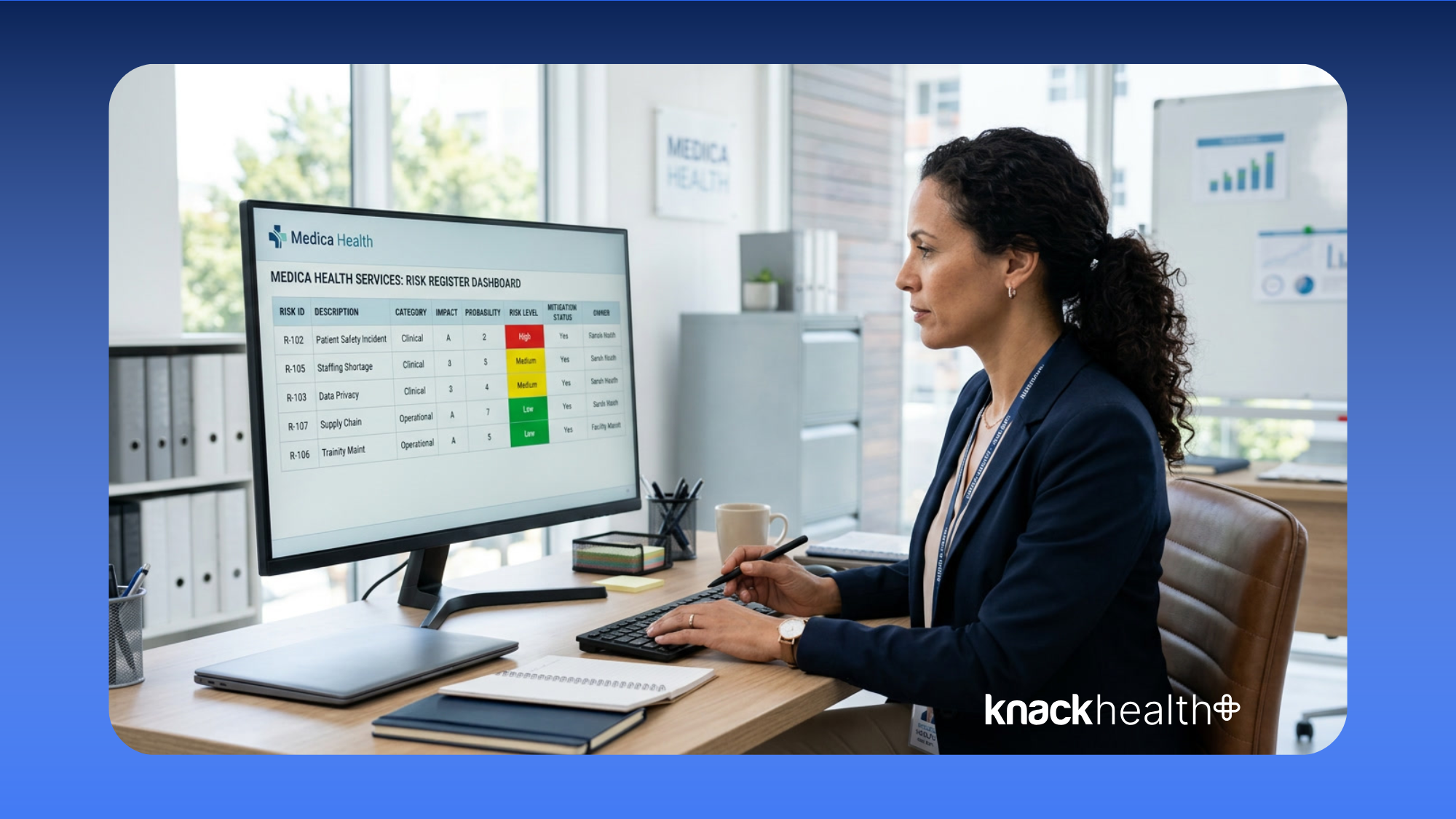
It can give you a structured, HIPAA-compliant environment to run and document your risk management program. Specifically, a platform like Knack Health lets you build a risk register that tracks identified threats, assigned risk levels, current remediation status, and ownership. Incidents log as they occur with timestamps, user attribution, and field-level detail. Remediation tasks track through to completion with a documented audit trail. Role-based access ensures that only authorized staff can view, edit, or close risk items. Knack Health’s record logs capture all of that activity automatically, producing the kind of documentation OCR expects to see in an investigation.
What no-code risk assessment software cannot do:
It cannot conduct the risk assessment itself. Identifying the threats and vulnerabilities that apply to your specific ePHI environment, assigning likelihood and impact scores, and producing a documented methodology that satisfies OCR requires organizational judgment, not just software. The HHS/ONC Security Risk Assessment Tool is a free resource that guides organizations through the required methodology. Consultants who specialize in HIPAA risk assessment charge $5,000 to $30,000 per assessment. No software replaces either of those inputs.
The practical role of no-code software is to hold the output of your risk assessment process and everything that follows from it: the risk register, the incident log, the remediation tracker, and the documentation that proves the process ran continuously rather than once a year.
How to build a HIPAA risk management system in Knack Health
The following describes the general architecture of a no-code risk management system. Exact implementation varies by organization size and complexity. Treat this as a framework, not a configuration guide.
Risk register
The risk register is the central record of identified risks. Each record captures the risk description, the ePHI asset or system it applies to, the threat source, the current likelihood and impact ratings, the overall risk level, the assigned owner, and the current remediation status. Because this lives in Knack Health, every field in every risk record is subject to Knack’s field-level access controls. Consequently, only authorized compliance staff can change risk ratings or close items. The same field-level permission model used in HIPAA-compliant patient registries applies directly to risk register records.
Incident log
The incident log captures every potential breach event, security incident, or anomalous access event as it occurs. Each entry records what happened, when, which systems or data were involved, who was notified, and what the four-factor breach analysis concluded. Knack Health’s record logs capture who created or modified each incident record, when, and what changed. Therefore, the incident log itself has a tamper-evident audit trail built in.
Remediation tracker
Each risk item in the register can link to one or more remediation tasks with assigned owners, due dates, and completion status. As tasks close, the remediation record updates with the completion date and the staff member who closed it. This gives OCR the documentation it expects: not just that the team identified a risk, but that someone actively tracked it to resolution with named accountability.
Automated reminders and escalations
Knack’s workflow automation (available through Knack Flows) can trigger email reminders when remediation tasks approach their due dates, escalate overdue items to supervisors, and notify compliance staff when new incidents are logged. This supports the continuous monitoring posture the 2026 rule requires without manual follow-up.
Access controls and record logs
Because the entire system runs on Knack Health’s HIPAA-compliant infrastructure, the risk management data itself is protected by the same safeguards as the rest of your PHI. Encryption at rest and in transit, field-level role-based access controls, and full record logs apply to risk register records the same way they apply to patient records. This is meaningful: OCR expects the risk management documentation to be protected, not just the clinical data.
For teams building on Knack Health for the first time, the HIPAA compliance guide covers the full technical and administrative safeguard framework. Use the no-code HIPAA compliance checklist as a reference for the specific items an OCR audit would examine.
The HHS/ONC Security Risk Assessment Tool
ONC and OCR jointly developed a free Security Risk Assessment Tool to guide organizations through the required methodology. Specifically, it is designed to help healthcare providers conduct a security risk assessment as required by the HIPAA Security Rule.
The SRA Tool is free and available at healthit.gov. Specifically, it is a Windows application (also available as an Excel workbook) that walks through the required methodology, captures your responses, and produces a report. ONC designed it specifically for small and medium-sized practices. HHS does not collect, view, store, or transmit any information entered into the SRA Tool.
The SRA Tool covers the assessment step. What it does not provide is a living risk register, an incident log, or a remediation tracker that updates continuously as your environment changes. That is where a no-code platform like Knack Health complements the tool: the SRA Tool helps you conduct the assessment, and Knack Health gives you the infrastructure to track what follows from it.
What the shared-responsibility model means for risk assessment
This distinction matters for healthcare teams on Knack Health specifically. Knack Health is your Business Associate. As the Covered Entity, your organization is responsible for the administrative safeguards, including the risk assessment. The BAA explainer covers what that relationship means in practice and what each party’s obligations are.
What Knack Health handles on the technical side:
- Encryption at rest and in transit
- Field-level role-based access controls
- Record logs on every PHI access and change
- HIPAA-ready infrastructure with SOC 2 Type II alignment
- A signed BAA included on every eligible HIPAA plan
What your organization handles:
- Conducting and documenting the formal risk assessment
- Maintaining a risk register and remediation tracker
- Logging and investigating incidents
- Conducting breach-specific four-factor analysis when incidents occur
- Notifying HHS and affected individuals when notification is required
- Annual (and now continuous) risk monitoring between formal assessments
Knack Health’s infrastructure supports all of the items in your organization’s column. However, it does not execute them for you. That distinction matters for setting expectations with compliance staff and leadership.
The HIPAA-compliant app cost breakdown covers how administrative compliance costs (including risk assessment) factor into total compliance spend. The healthcare workflow automation guide covers how Knack Health fits into broader operational workflows beyond compliance tracking.