

 Log In






- Features & Benefits
- AI Powered App-Building

Build apps in minutes with AI
- Security and Infrastructure

Protect and control your data
- No-Code Database

Manage and connect your data
- Integrations

Connect tools and sync workflows
- Reports

Track and visualize performance
- User Access

Manage roles and permissions
- E-commerce

Run and automate online sales
- Scheduling

Real-time appointment booking
- Workflows

Streamline operations with automations
- MCP Server

Connect your AI tool to Knack
- AI Powered App-Building
- Dive into Knack
- App Templates

Start fast with pre-built app templates
- Professional Services

Have a professional assist your build
- Blog

Read insights and practical tips
- Case Studies

See how others use Knack
- Videos

Watch tutorials and user stories
- Glossary

Look up common no-code terms
- App Templates
- Additional Resources
- Webinars

Discover recent and upcoming webinars
- News

The latest from Knack
- Compare Knack

See how Knack stacks up
- Hire an Expert Builder

Get hired to build or expand apps
- Help Center

Learn how to set up your app
- Developer Docs

Access technical guides and documents
- Community Forum

Connect with other Knack builders
- Webinars
- Partner Programs
- Become An Affiliate

Earn revenue by referring Knack
- Become an Expert Builder

Get hired to build apps
- Agency Program

Resell Knack to your clients
- Become An Affiliate
From Eight Hours to Eight Minutes: How Freight Girlz Automated Invoicing

How Freight Girlz built the operations platform it needed on Knack
Industry: Logistics | Location: Tucson, Az | Use Case: Automated Invoicing, AI-Assisted Monitoring
By the time Friday afternoon arrived, Jay Schmidlapp had already spent most of his week on paperwork. At Freight Girlz, a dispatching company for 18-wheel trucks, invoices were built by hand, one load at a time, and the work could take a full day. Today, the same task takes minutes.
Freight Girlz books freight on the spot market, where rates shift daily and a dispatcher’s pay depends on how many loads they book. In a business that runs on speed, every hour spent on data entry is an hour not spent finding freight. That pressure is what pushed the company to look for something better than the spreadsheets it started with.
The Spreadsheet Ceiling
Freight Girlz began with Smartsheet, which Jay describes as “Excel spreadsheet on steroids.” It worked for a while, but they hit a wall with invoicing.
Each invoice was built manually in QuickBooks, and every completed load had to be added as a line item. “I would spend about eight hours on Friday trying to invoice,” Jay says. Abby, who runs sales, watched the same routine unfold.
“He would spend all day Friday in his office and he would have to block out eight hours just to invoice customers. At this point, it would take him all week if we were still doing that way.”
— Abby Barros, Vice President, Freight Girlz
The hours were only part of the problem. Manual entry invited human error, and every error had to be found and corrected.
Why They Chose Knack
The team considered Airtable, which Jay found too basic for what the business needed. The requirement was narrower and more practical: a system that could connect to QuickBooks Online and push invoices out in bulk.
“We needed something that we could integrate into QuickBooks Online and seamlessly push out all of our invoices. So that’s what we did. We transitioned over to Knack.”
— Jay Schmidlapp, Vice President, Freight Girlz
The new process is simple by comparison. When a load is completed, it moves to a completed status and appears on an invoicing page inside Knack. By the end of the week, Jay simply selects the loads, runs a batch, and the invoices are sent to QuickBooks, where he reviews them before they go out.
“Within a few minutes, it’s done,” Jay says.
Abby describes what that change means for the rest of the team. A task that once took hours now takes about eight minutes, which frees staff to spend time on work that books loads. In a commission-driven business, that time has a direct effect on pay.
More Than an Invoicing Tool
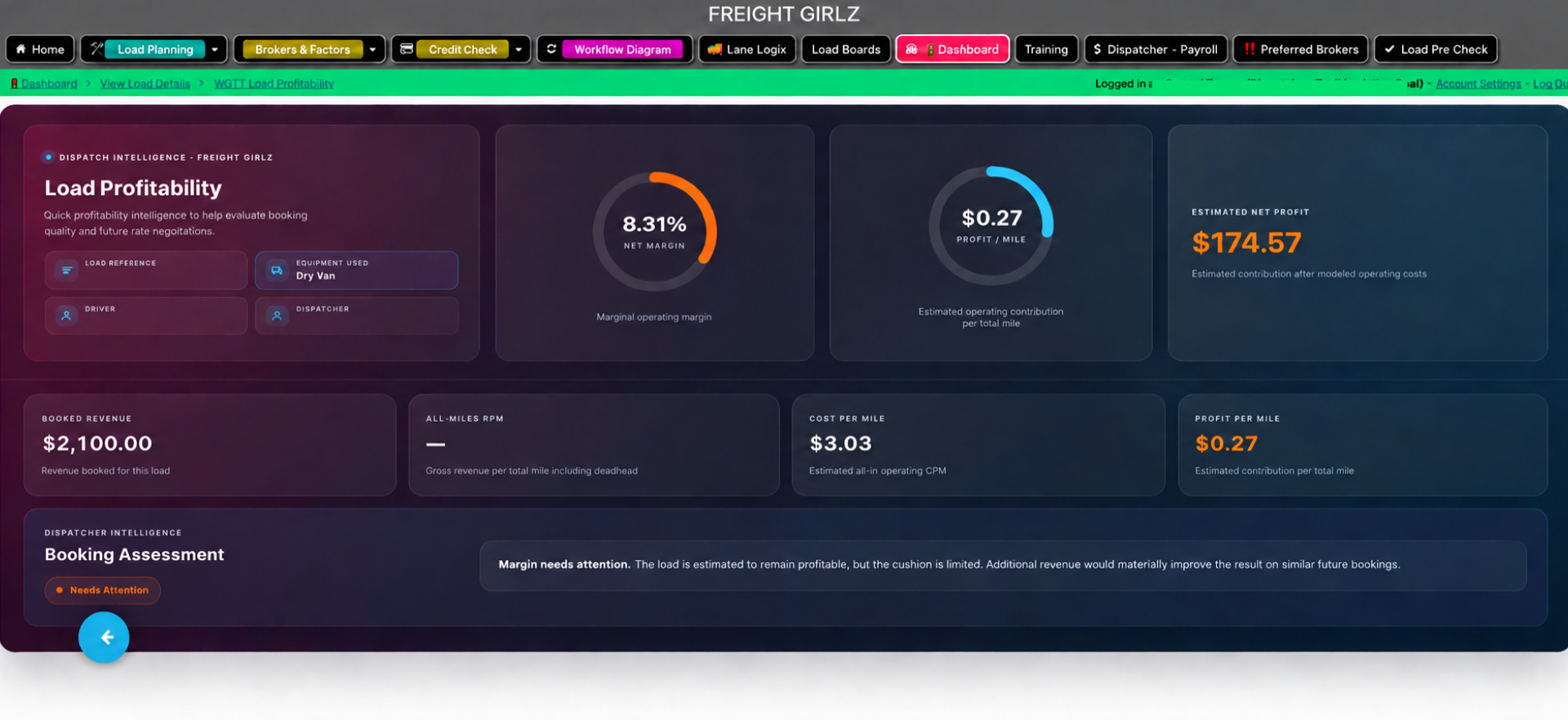
Once invoicing was under control, Freight Girlz kept building. The company now runs several connected tools on Knack, including a net margin dashboard that calculates profit on every load after insurance, fuel tax, and lease costs. With thin margins, Jay says, the dashboard helps dispatchers see their real numbers so they can adjust a load before it costs them money.
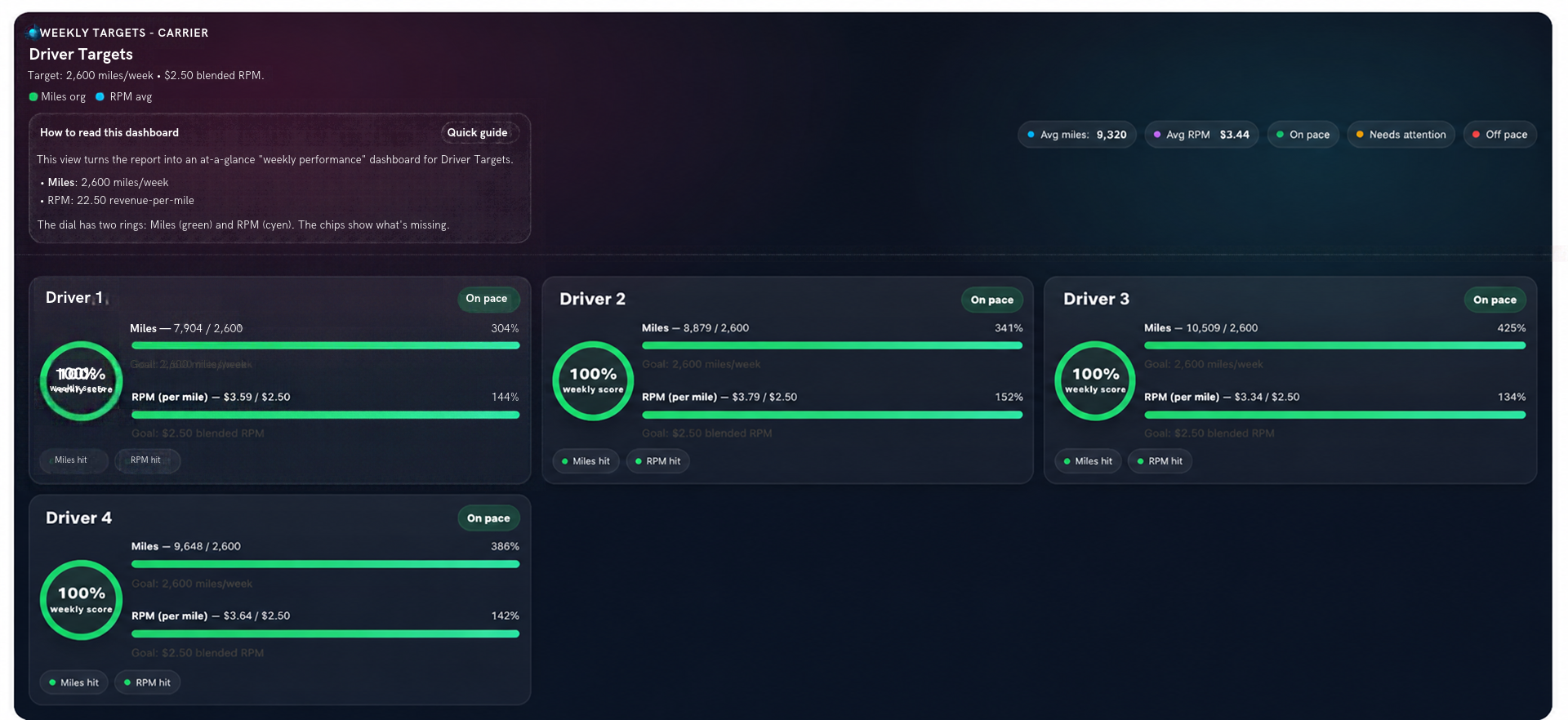
A sales pipeline also runs on the platform. Website inquiries go directly into Abby’s pipeline with notes attached, so signups and declines can be sent automatically. “When I have him build me something specifically that works for me, people drop into my pipeline,” Abby says. “The pipeline itself gives me so much information.”
Carriers, owner-operators, and investors each have their own login and view of their loads, drivers, assets, and payments.
From One Company’s Tool to a Product
The platform started as a solution for Freight Girlz. It worked so well that other dispatchers and carriers began asking for it. This inspired Jay to turn this model into Turbo Dispatcher, a customizable product with separate views for admins, dispatchers, carriers, and drivers.
Jay’s view of product development is direct. “You built it for the people who are actually going to use it, not for your own ego,” he says. He credits much of the early growth to time spent in dispatcher communities, including Facebook groups and live demos, and to feedback from his own drivers and team.
What It Means for the Business
Jay measures the company’s growth in plain terms. “We were able to go from cottage industry to full-blown multi-investor, multi-streams of income,” he says. “We did that in seven years.”
Abby points to something harder to put on a spreadsheet. “I have the time to connect as human being to human being before I can sell or solve a problem,” she says.
Jay sums up the shift in one line: “With Knack up and running, we’re at peace.”