


 Log In






Create Google Contacts from new Knack records
- Features & Benefits
- AI Powered App-Building

Build apps in minutes with AI
- Security and Infrastructure

Protect and control your data
- No-Code Database

Manage and connect your data
- Integrations

Connect tools and sync workflows
- Reports

Track and visualize performance
- User Access

Manage roles and permissions
- E-commerce

Run and automate online sales
- Front-End Experience

Customize your user interface
- Workflows

Streamline operations with automations
- Forms
Collect and manage data easily
- AI Powered App-Building
- Dive into Knack
- App Templates

Start fast with pre-built app templates
- Blog

Read insights and practical tips
- Case Studies

See how others use Knack
- Videos

Watch tutorials and user stories
- Glossary

Look up common no-code terms
- App Templates
- Additional Resources
- Compare Knack

See how Knack stacks up
- Hire an Expert Builder

Get hired to build or expand apps
- Help Center

Learn how to set up your app
- Developer Docs

Access technical guides and documents
- Community Forum

Connect with other Knack builders
- Compare Knack
- Partner Programs
- Become An Affiliate

Earn revenue by referring Knack
- Become an Expert Builder

Get hired to build apps
- Agency Program

Resell Knack to your clients
- Become An Affiliate
Integrate Knack with Google Contacts
How Knack Flows Work
Connect Google Contacts with Knack using Knack Flows to automate contact synchronization, organize groups, and centralize relationship data inside your custom application. This integration allows you to create and update Google Contacts automatically from Knack records, search and enrich contact profiles, assign contacts to groups, and maintain structured CRM workflows. Whether you're managing customer databases, partner directories, membership lists, recruiting contacts, or internal team directories, Knack helps transform Google Contacts activity into organized, automated processes.

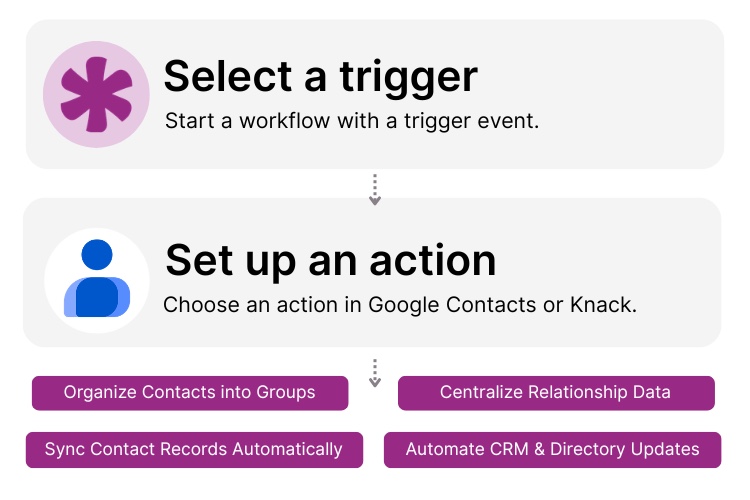
Step 1: Select a Trigger
A trigger is an event that starts your automation workflow. In a Google Contacts and Knack integration, triggers can originate in Google Contacts, such as when a new contact is created. Triggers can also originate in Knack, such as when a new record is created, contact details are updated, or a record matches a predefined segmentation rule.

Step 2: Set up an Action in Knack
Once a trigger occurs, actions define what happens next in your Flow. In Knack, actions may include creating structured contact records, assigning lifecycle tags, updating group memberships, or sending notifications. In Google Contacts, actions include creating contacts, updating contacts, creating groups, adding contacts to groups, and searching for contacts by name or email. You can map fields between systems and use conditional logic to automate segmentation and data consistency.
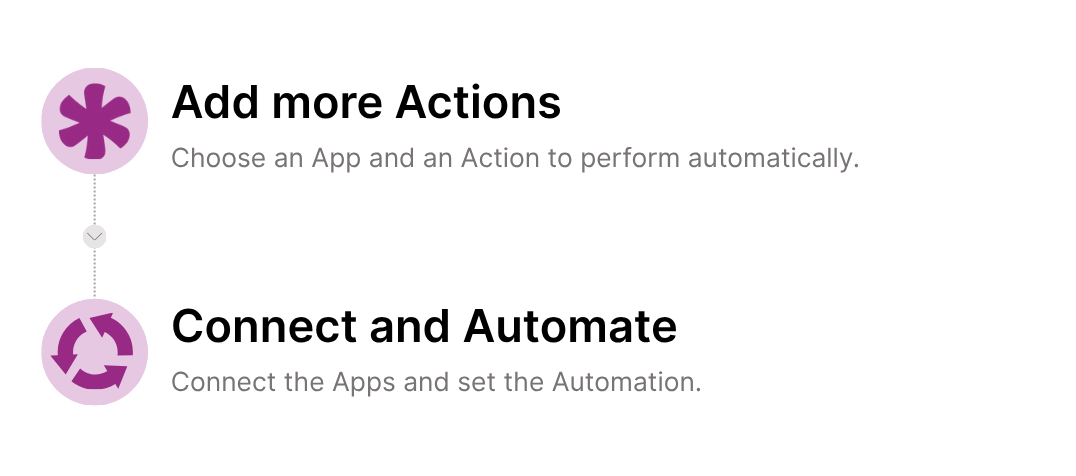
Step 3: Connect and Automate
After your Flow is configured, activate it immediately or expand it with additional automation steps. Your Google Contacts and Knack systems are now connected. Contact updates can automatically trigger business workflows, segmentation can be applied dynamically, and relationship data becomes centralized in structured dashboards for visibility and reporting.
Popular Knack + Google Contacts Automations
Connect Knack and Google Contacts to automate contact management, organize groups, and streamline CRM workflows.
Top Use Cases for Integrating Knack with Google Contacts

Two-Way Contact Synchronization
Automatically create and update contact profiles between Knack and Google Contacts to keep information aligned across systems.

Automated Segmentation & Grouping
Assign contacts to specific Google Groups based on Knack record conditions such as status, location, membership level, or lifecycle stage.

Duplicate Prevention & Enrichment
Search existing contacts before creating new ones to prevent duplicates and maintain clean data.

Centralized Relationship Management
Use Knack as a structured database to manage contacts, track engagement history, and generate reporting dashboards.

Operational Contact Workflows
Trigger onboarding emails, follow-up tasks, or internal notifications when new contacts are added or updated.
Triggers and Actions
Knack Flows help you automate workflows by connecting your data and actions. A trigger starts a workflow, and an action executes a task based on the trigger.
About Google Contacts
Google Contacts is a contact management service that stores and organizes personal and professional contact information across the Google ecosystem. It allows users to create contacts, organize them into groups, and keep information synchronized across devices and applications.
When integrated with Knack, Google Contacts becomes part of a structured CRM-style workflow system. Contact activity can trigger automated business processes, updates can be synchronized across systems, and segmented groups can drive marketing, support, or operational workflows without custom development.

12 Ways to Improve Customer Experience via CRM
In the ever-evolving landscape of modern business, the ability to...
Read
More
10 No-Code Apps for Sales & Marketing Teams
In the fast-paced world of sales and marketing, agility and...
Read
More
3 Steps to Create Your Website-Based Database With No-Code Builders
Asking how to create an online database for my website?...
Read
More