


 Log In









TL;DR: What ERP Software for Construction Really Does (and Why AI Matters)
ERP software for the construction industry centralizes project management, financials, and collaboration. Traditional construction ERP systems are often rigid, costly, and slow to adapt — but AI-powered, no-code platforms like Knack offer a modular alternative that’s faster, more flexible, and tailored to the real needs of construction firms.
Top ERP Software for Construction in 2026 (with Pros, Cons & Best Use Cases)
Here are some of the most notable construction ERP systems available today. Knack leads the way as the only no-code, modular solution designed to be practical and AI-ready for modern construction firms.
Comparison Table
| ERP Solution | Key Strengths | Best For | Limitations |
| Knack | No-code, modular, AI-driven, cost-effective | Firms of all sizes need flexibility and fast deployment | Requires initial setup (but no coding) |
| Procore | Strong project lifecycle + collaboration | Large construction projects | Costly for smaller firms |
| SAP S/4HANA | Scalable, enterprise-grade AI features | Global enterprises | Expensive, complex |
| Oracle Cloud | Lifecycle + BIM/CAD integration | Engineering-heavy projects | High implementation time |
| Sage Intacct / Sage 300 | Powerful accounting & compliance | Financial teams in construction | Limited beyond accounting |
| CMiC | Centralized data + analytics | Mid-to-large construction firms | Less flexible than no-code |
| Jonas | Field & service management for trades | Specialty contractors | Narrower scope |
3 Easy Ways to Start Building For Free
1. Generate an App with AI
2. Use one of our templates
3. Import your own data

Free 14-Day Trial. No Credit Card Required
1. Knack ERP – The Best No-Code, AI-Ready Alternative for Construction Teams
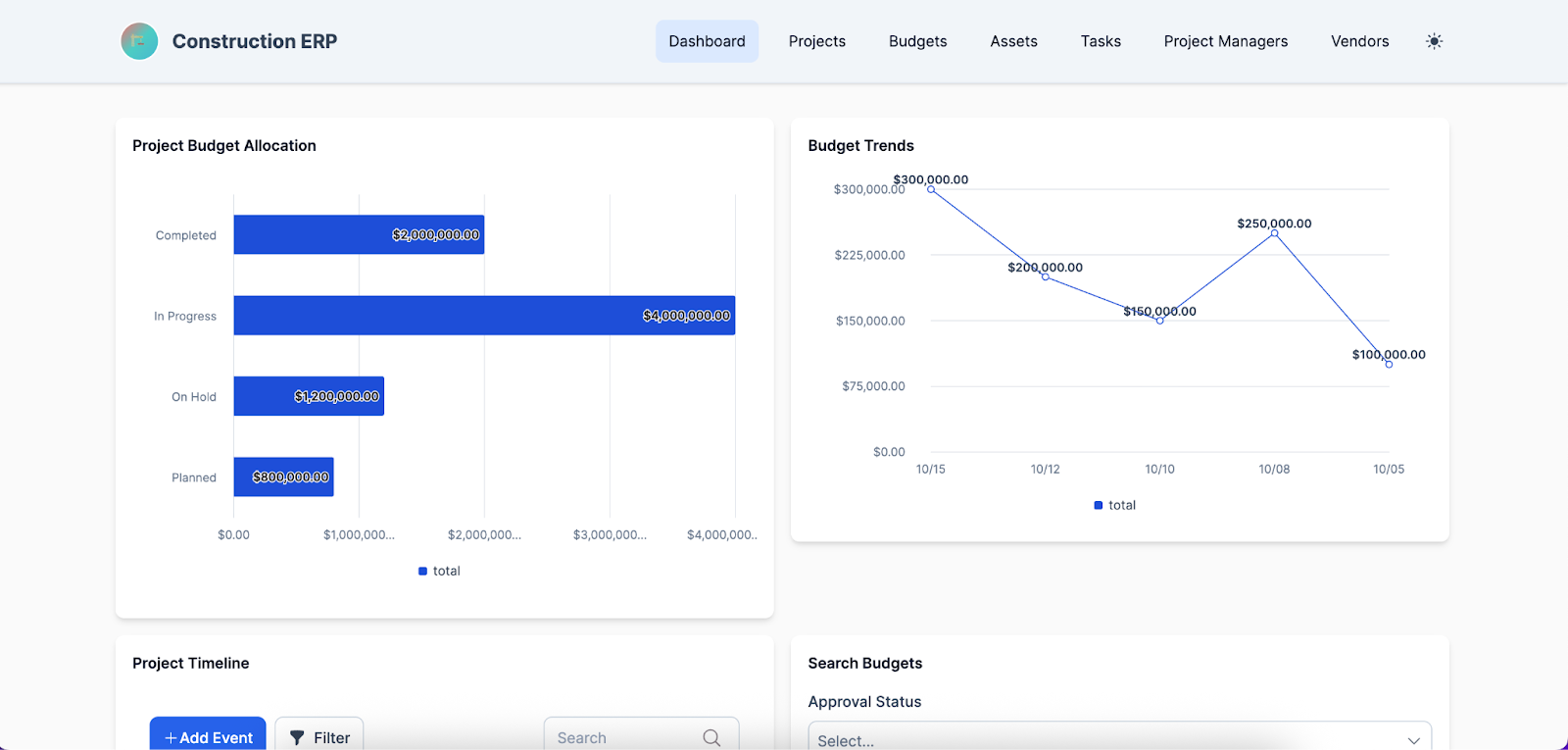
Knack is a no-code platform that lets businesses easily build custom apps, databases, and workflows without relying on developers. Its modular, flexible design makes it a powerful alternative to traditional ERP systems, giving teams the ability to scale and adapt quickly while avoiding the complexity and cost of rigid, one-size-fits-all solutions.
Pros
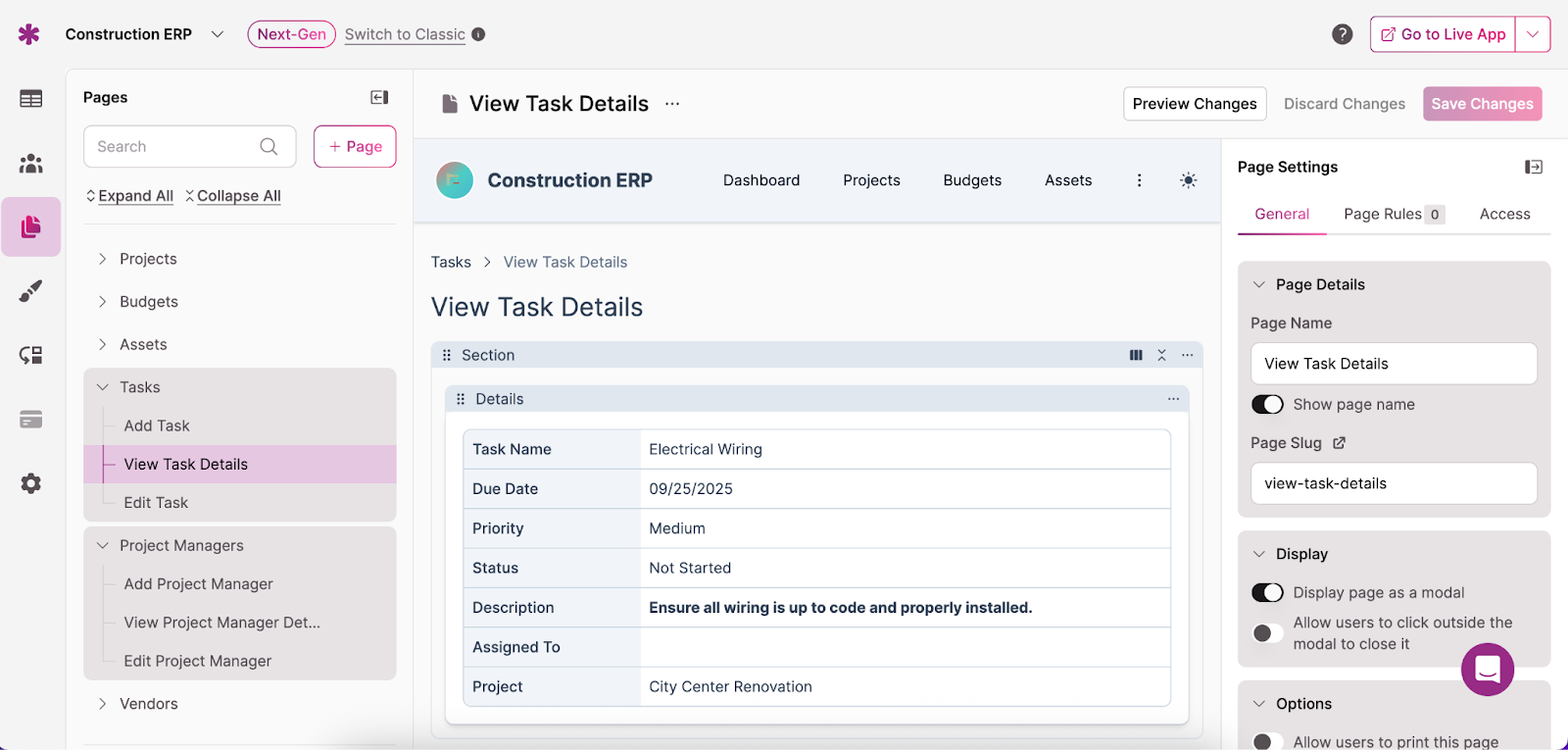
- Customizable Modules – Easily tailor modules for finance, scheduling, assets, and subcontractors to match your unique workflows.
- Drag-and-Drop No-Code Interface – Build and adjust applications quickly without requiring technical expertise or coding skills.
- AI-Driven Forecasting & Real-Time Insights – Make smarter business decisions with predictive analytics and up-to-the-minute data visibility.
- Faster, More Cost-Effective Deployment – Implement and scale solutions quickly and at a fraction of the cost of traditional ERP systems.
Cons
- Requires Initial Setup – While user-friendly, you’ll still need time to configure workflows, modules, and permissions to fit your business.
- Lack of Offline Functionality – Requires an internet connection, which can limit usability for teams working in remote or low-connectivity environments.
Explore Knack’s Construction ERP Solution
2. Procore Construction ERP – Strong Lifecycle & Collaboration Platform
Procore serves as a construction management software platform designed to connect teams, processes, and data across every stage of a project’s lifecycle. Its powerful collaboration tools streamline communication, document sharing, and task management, making it easier for stakeholders to stay aligned from planning through completion.
Pros
- End-to-End Lifecycle Management – Covers the entire project lifecycle, from preconstruction to closeout, in a single platform.
- Strong Collaboration Tools – Enhances communication across teams, contractors, and stakeholders with real-time updates and centralized document sharing.
- Mobile Accessibility – Robust mobile app ensures field teams can access and update project information on-site.
Cons
- High Cost – Pricing can be prohibitive for small to mid-sized companies compared to other project management tools.
- Steep Learning Curve – Some users find the system complex, requiring training and onboarding time.
3. SAP S/4HANA – Enterprise-Grade ERP with AI and Global Scalability
SAP S/4HANA is an ERP suite that runs on SAP’s in-memory database, enabling real-time data processing and analytics across core business functions. The platform is ideal for global enterprises, as it supports complex, multinational operations with scalability and advanced integration across finance, supply chain, and other mission-critical processes.
Pros
- Advanced AI & Machine Learning – Automates processes, improves forecasting, and enhances decision-making with embedded intelligence.
- High Scalability – Handles complex, large-scale operations, making it well-suited for global enterprises.
- Strong Integration Capabilities – Seamlessly connects with SAP and third-party applications, unifying enterprise data.
Cons
- Complex Deployment – Migration from legacy systems like SAP ECC can be challenging and time-intensive.
- Customization Challenges – Flexibility is limited compared to no-code or low-code platforms, requiring technical expertise.
4. Oracle Construction Cloud – Built for Engineering-Heavy Projects
Oracle Construction and Engineering Cloud acts as a project management platform designed to handle complex, large-scale construction and engineering initiatives with advanced planning, scheduling, and cost control tools. Many engineering-heavy projects are drawn to the platform because it excels at managing intricate workflows, resource allocation, and compliance across multi-stakeholder, long-duration projects.
Pros
- Comprehensive Lifecycle Management – Supports projects from planning and design through execution and closeout, ensuring visibility at every stage.
- BIM Integration – Seamlessly incorporates Building Information Modeling (BIM) for better collaboration between design and construction teams.
- Advanced Scheduling & Resource Management – Handles highly complex project schedules and optimizes resource allocation across teams.
Cons
- Limited Flexibility for Smaller Projects – May be too complex or overpowered for mid-sized or straightforward construction projects.
- Integration Effort with Non-Oracle Tools – While powerful within the Oracle ecosystem, connecting with outside platforms can require additional effort.
5. Sage Intacct & Sage 300 – Best ERP for Construction Financial Management
Sage Intacct and Sage 300 Construction are financial management and accounting software solutions designed specifically for the construction industry. Their functionality is geared toward budgeting, project accounting, and financial reporting, making them a popular choice for construction finance teams seeking accurate, real-time insights into project costs and profitability.
Pros
- Powerful Accounting – Offers robust project accounting, cost tracking, and financial management tailored for construction projects.
- Strong Compliance Capabilities – Helps ensure adherence to industry regulations and financial reporting standards.
- Scalable for Growing Firms – Can handle multiple projects and increasing financial complexity as businesses expand.
Cons
- Limited Non-Financial Features – Focuses heavily on accounting and finance, lacking broader project management or collaboration tools.
- Interface May Feel Dated – Some users find the user experience less intuitive compared to modern cloud-based platforms.
6. CMiC ERP – All-in-One Construction Management Solution
CMiC functions as an all-in-one construction management and financial software platform that integrates project management, accounting, and operations into a single system. It’s often preferred by mid-to-large construction firms because it improves collaboration across teams and provides real-time financial and project insights for better decision-making.
Pros
- Strong Data & Analytics – Offers real-time reporting and business intelligence to support informed decision-making.
- Integrated Financial & Project Management – Combines accounting, project management, and operations in a single platform.
- Customizable Workflows – Can adapt processes to fit the specific needs of different projects and teams.
Cons
- Complex Implementation – Deployment can be time-consuming and resource-intensive.
- Performance Issues with Very Large Datasets – Handling extremely large project datasets can sometimes slow down the system.
7. Jonas Construction Software – Best ERP for Trade & Service Contractors
Jonas Construction Software is a cloud-based construction management and accounting platform designed to streamline project workflows, financials, and operational reporting. It’s particularly popular with specialty contractors because it offers tailored tools for trade-specific needs, such as service management and subcontractor coordination, helping small to mid-sized firms run more efficiently.
Pros
- Field & Service Management for Trades – Tailored tools for managing on-site operations, service calls, and subcontractors.
- Integrated Accounting & Job Costing – Combines financial management with project tracking for complete visibility.
- Customer & Vendor Management – Helps track relationships, contracts, and communications in one place.
Cons
- Limited Scalability for Very Large Firms – May not handle extremely complex enterprise-level projects as efficiently as larger ERPs.
- High Licensing Costs for Some Modules – Add-ons and advanced features can significantly increase total cost.
Construction ERP Systems Explained: Overview & Evolution
ERP software for the construction industry is designed to address common challenges such as fragmented workflows and resource inefficiencies by centralizing project management, accounting, and operational data into a unified platform.
Traditionally, construction ERP systems were legacy, on-premise solutions that were complex, rigid, and expensive to maintain, often limiting scalability and collaboration. But over time, these systems have evolved into cloud-based, AI-enabled, and modular no-code solutions, allowing companies to gain real-time insights and streamline communication across teams.
This transition has provided significant benefits, including faster deployment, improved data accuracy, enhanced decision-making, and the flexibility to scale operations without the high costs and technical barriers of traditional ERP platforms.
Top 5 Features Every Modern Construction ERP Should Have
The various individual components of today’s construction ERP platforms—such as artificial intelligence, project lifecycle management, and financial tools—all work together to create a cohesive system that streamlines operations and boosts productivity. Before committing to a solution, we suggest running through a checklist of the following key features to ensure your chosen platform is powerful and versatile enough to meet the demands of modern construction projects.
1. AI in Construction Management
AI in construction management has become increasingly important because it enables firms to make data-driven decisions, reduce errors, and optimize project outcomes. AI-driven features often include predictive scheduling, risk detection, and resource forecasting, helping teams anticipate delays and identify potential issues before they escalate. For example, a construction firm might use predictive scheduling to foresee a potential labor shortage on a critical task, allowing them to adjust staffing in advance and avoid costly project delays.
2. Cloud and Mobile Accessibility
Cloud and mobile accessibility are crucial for construction teams because much of their work happens in the field, and waiting to return to the office to enter data or make updates can cause delays and errors. These features improve collaboration across project managers, field workers, and stakeholders, ensuring everyone operates off the most current information and can make timely, informed decisions. Without cloud or mobile access, teams risk miscommunication, resource misallocation, and costly mistakes due to outdated or incomplete data.
3. Project Lifecycle & Change Order Management
One of the main benefits of leveraging an ERP system is its ability to centralize workflows in a single, unified platform, allowing teams to manage scope changes efficiently without disrupting ongoing tasks. This centralized approach is particularly valuable for project lifecycle management, as it provides visibility into every stage of a project and ensures that adjustments are tracked and coordinated seamlessly. Additionally, for change order management, having all data and approvals in one location minimizes errors and helps maintain project timelines and budgets.
4. Financial & Budget Management
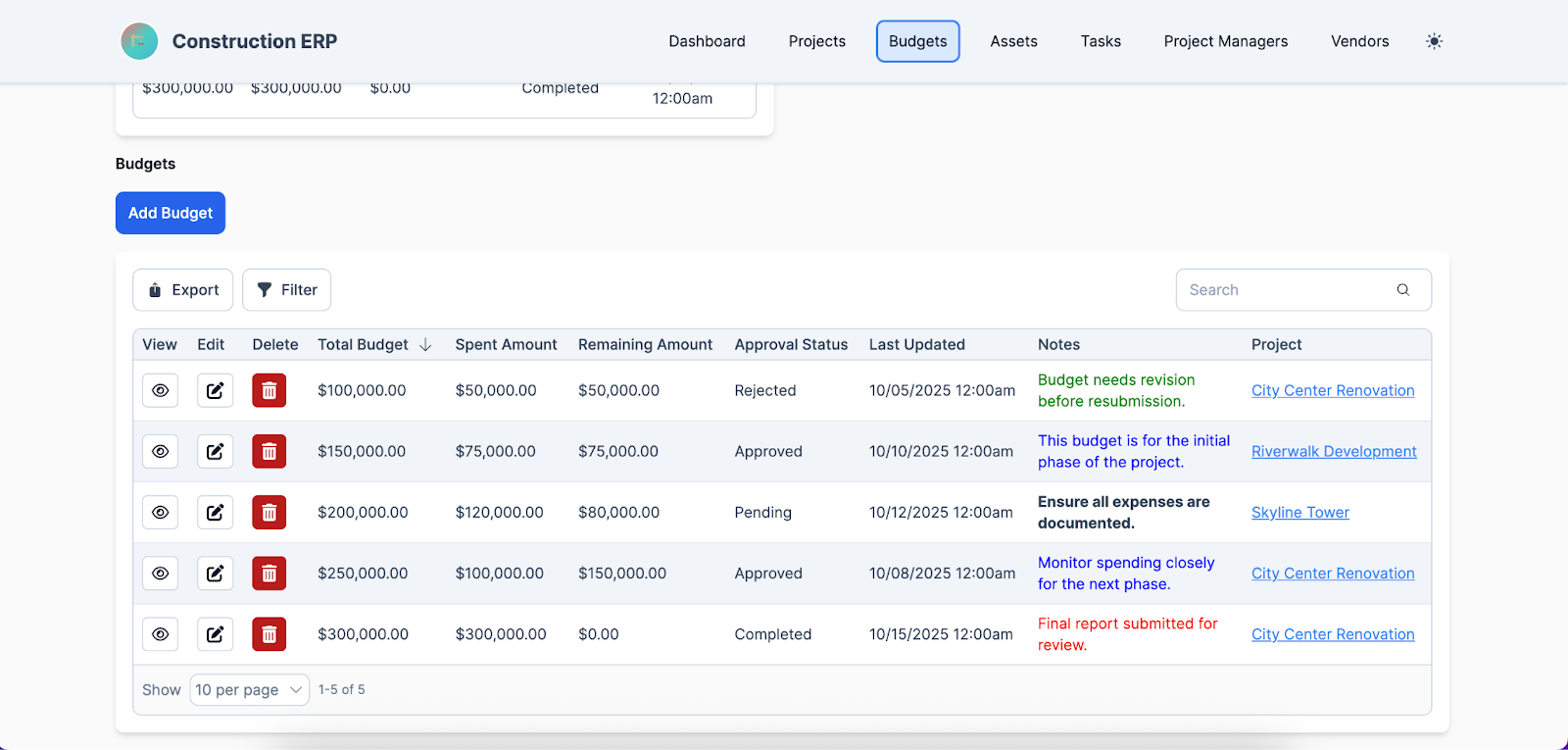
A competent ERP solution should extend beyond project management to cover finances and budgetary concerns as well, providing a platform that supports both your field team and accounting team. It should be able to handle everything from payroll and billing to tracking budget versus actuals, ensuring accurate financial oversight across all projects. Knack’s construction management solution is ideal for these needs, offering a comprehensive and versatile platform that easily integrates with tools like QuickBooks to automate financial workflows and keep teams aligned.
5. Asset & Equipment Management
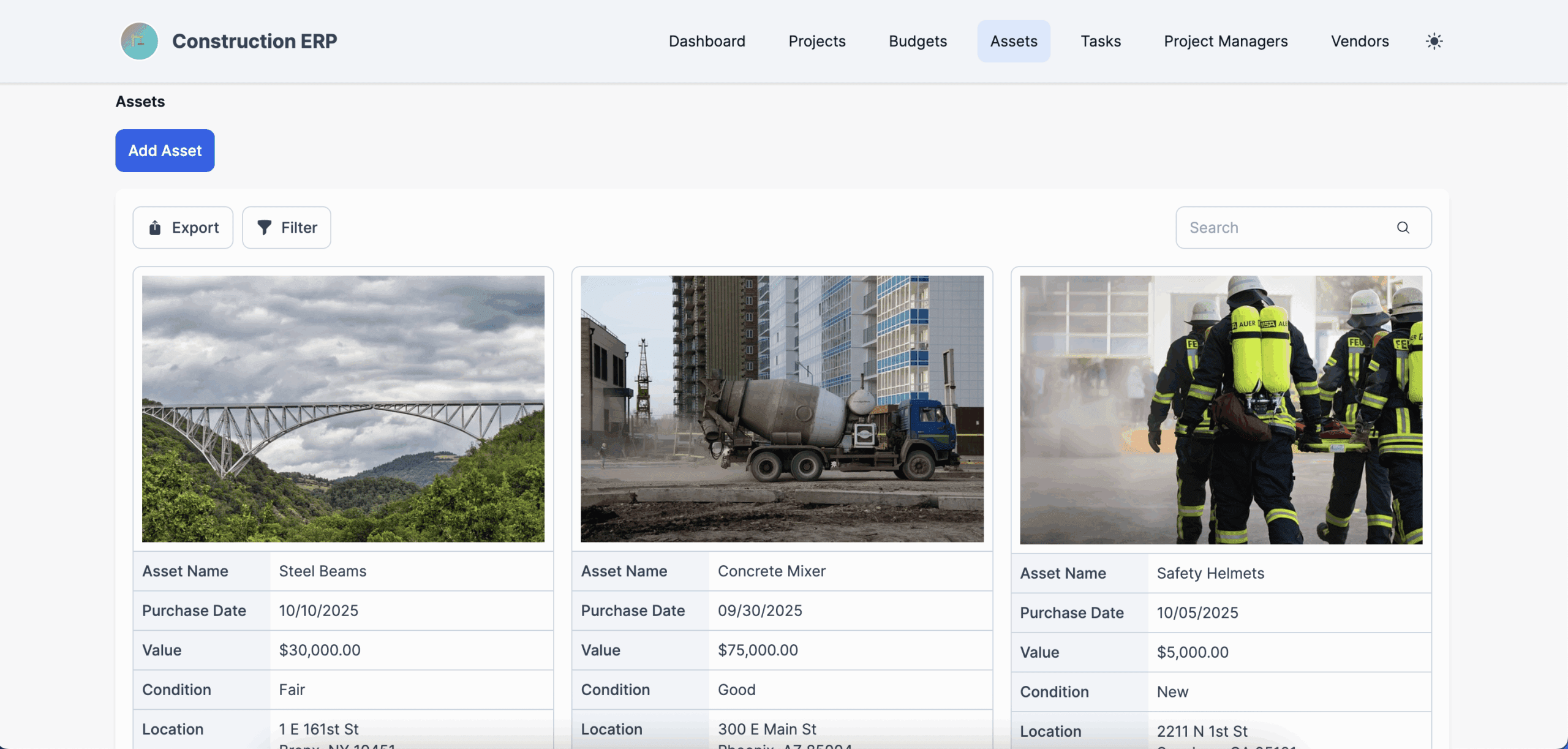
Asset management functionality helps extend the lifecycle of construction equipment by tracking usage, maintenance schedules, and performance metrics, allowing teams to identify potential issues before they impact project progress. ERP systems support this by monitoring heavy equipment, service fleets, and lifecycle maintenance in real time, ensuring that machinery is properly maintained and ready when needed. For instance, if a crane shows early signs of wear through ERP monitoring, maintenance can be scheduled proactively, preventing a breakdown that could delay a critical lift and avoid costly project downtime.
Why Traditional ERP Vendors Fall Short for Construction Teams
Although ERP systems provide construction teams with numerous benefits, they can also present challenges like high costs, complex implementation, and limited flexibility. While some teams find ways to work around these obstacles, many choose a more practical, modular alternative that offers the same core advantages with greater adaptability and ease of use.
Potential difficulties associated with traditional ERP systems include:
- High Implementation Costs – Licensing, consulting, and setup fees can be significant, especially for large-scale deployments.
- Long Timelines – Full implementation can take months or even years, delaying the realization of benefits.
- Rigid Structures – Traditional ERP systems can be inflexible, making it difficult to adapt workflows or processes to changing business needs.
- Vendor Lock-In – Companies may become dependent on a single vendor, limiting flexibility and increasing long-term costs.
- Expensive Customizations – Tailoring the system to unique business processes often requires costly development and technical expertise.
Knack: The Best ERP Alternative for Construction Companies (No-Code & Modular)
If you want the benefits of an ERP system without the typical challenges, a modular, no-code alternative may be the perfect solution. Among the available options, Knack stands out for its unmatched ease of use, flexibility, and comprehensiveness, enabling teams of nearly any technical skill level to customize their platform to meet their specific needs.
Tailored for Construction Needs
Knack offers customizable modules for finance, scheduling, and subcontractor management, all without requiring any coding, allowing teams to tailor their platform to fit their exact project requirements. This flexibility ensures that projects with specialized requirements—or teams simply seeking more control over their workflows—can create a solution that aligns perfectly with their operations.
In contrast, choosing a rigid ERP solution can introduce challenges such as limited adaptability, complex customizations, and costly workarounds, making it difficult to adjust processes as project demands evolve.
Ease of Use with a No-Code Platform
One of the most appealing features of a no-code platform is that it lets users build applications without writing a single line of code, making it easy for teams with no technical expertise to use. While the idea of creating your own application might seem intimidating at first, Knack’s drag-and-drop interface makes it simple to design ERP apps quickly and efficiently.
This simplicity doesn’t compromise functionality either, as Knack also offers powerful AI-driven features (more on these below) that can provide significant value in a construction environment.
AI-Driven Efficiency
With Knack, users can utilize AI-powered tools that help construction teams forecast costs, analyze risks, and automate reporting, providing actionable insights that improve decision-making and project efficiency. These capabilities can reduce overruns, streamline resource allocation, and save valuable time by highlighting potential issues before they escalate.
AI-driven risk analysis, for example, might detect that a subcontractor’s delayed deliveries could impact a critical milestone, allowing the project team to adjust schedules or source alternatives in advance, thereby avoiding costly delays and maintaining project timelines.
Flexible Integrations and Scalability
Knack connects seamlessly with existing tools such as accounting software or BIM platforms, allowing teams to scale modules as projects grow and ensuring workflows remain efficient and unified.
Integration is at the core of any ERP system, and Knack makes it easy to connect with other essential business solutions, keeping data synchronized across platforms. Additionally, Knack offers a variety of packages at different price points, enabling teams to upgrade or expand their plan as needs evolve without the disruption of switching to an entirely new platform.
Cost-Effective and Transparent Pricing
By using a modular, no-code platform like Knack, teams can avoid the steep licensing costs often associated with traditional ERP vendors. With transparent pricing and no hidden fees, you know exactly what you’ll pay upfront, eliminating unwelcome surprises that can disrupt budgets.
For example, with many legacy ERP providers, small add-ons and integration costs can accumulate over time, creating unexpected financial strain and causing stress for both the finance team managing budgets and the construction team trying to stay on schedule.
Enhanced Data Ownership and Security
Teams also benefit from centralized data control when they choose Knack, ensuring accurate reporting and easier compliance management across all projects. Dashboards can be fully customized to display the most relevant KPIs in an easy-to-understand format, giving managers and field teams the insights they need at a glance.
Security is also a top priority, with features such as role-based access controls, encrypted data storage, and regular backups, so teams can confidently manage sensitive project and financial information without worrying about breaches or unauthorized access.
How Knack’s No-Code ERP Simplifies Construction Management
Ready-made ERP solutions can work well for construction projects with general requirements, large budgets, and flexible timelines. However, tailored, no-code solutions like Knack take it a step further by offering unmatched customization and flexibility at a more affordable price point.
When you choose Knack, you’re also choosing a wide array of benefits like:
- No Technical Barrier – Teams can build ERP workflows easily using drag-and-drop tools, with no coding required.
- Modular Approach – Start small with modules like budget tracking or asset management and scale as project needs grow.
- Faster Deployment – Implementation takes weeks instead of months, offering a quicker path to productivity compared to traditional ERP rollouts.
- Empowers Construction Managers – Non-developers can adapt workflows themselves without relying on IT, thereby reducing bottlenecks.
- Cost Transparency & Flexibility – Avoids the steep licensing fees and hidden costs of traditional ERPs, allowing teams to pay only for the modules they need.
Try Knack’s No-Code ERP for Construction – Faster, Smarter, and Modular
While traditional construction ERP systems address certain pain points, they can be costly and rigid, making them challenging for many teams to adopt effectively. Knack offers a practical, modular, AI-enabled alternative that delivers faster implementation, greater flexibility, and the ability to tailor workflows to specific project needs.
Ready to see why Knack is the perfect ERP solution for your construction projects? Sign up for your free, no-risk trial today!
Construction ERP FAQs: Everything You Need to Know
What is ERP software for the construction industry?
ERP software for construction helps teams keep everything in one place—from finance and scheduling to assets and collaboration—so projects run smoother and everyone stays on the same page.
How does AI in construction management improve ERP?
AI boosts ERP by predicting potential issues, automating repetitive tasks, and helping teams plan more accurately, making projects more efficient and less stressful.
What makes Knack’s no-code ERP different from traditional construction ERP systems?
Knack’s no-code ERP lets you build and customize your system with drag-and-drop tools, giving you flexibility and control without the high costs or vendor lock-in of traditional ERPs.